Tuesday, February 20, 2007

A-bike - the world's most compact and lightest folding bike - by Sir Clive Sinclair

So named, because of its ‘A’ like shape, the uniquely styled A-bike feels much like a normal bike to ride, however, unlike other folding bikes it can easily be slipped into bag while you hop on the tube, train, bus, or even a plane. A-bike is half the weight, half the size & half the price of any other folding bike!
Sir Clive explains “The principle use for the A-bike is city or town travel over relatively short journeys but also very much for mixed-mode journeys where you’re hopping on and off a bus or a train. For example a typical commuter needs to get from home to local station and then from destination to his or her office – and all without any worries about portability, parking or security.”
“The key to its successful introduction,” adds chief designer, Alex Kalogroulis, “is an entirely fresh approach to the main challenge: how to minimise weight and optimise foldability while retaining full functionality. At the heart of the solution are light, highly-reliable telescopic tubes coupled with telescoping brake cables."
Despite the wheels small size, the use of a dynamically geared twin chain system enables users to pedal normally and retain their balance. The high performance 90psi pneumatic tyres allow for a smooth and comfortable ride on most hard surfaces. The wheel size a key factor in making the bike so lightweight and compact.

The internal twin chain system is totally encased at the rear of the A-bike which has the benefit of keeping grease and dirt away from clothes and hands. The A-bike has a single, easy to use, gear transmission.

A-bike is designed to be folded and unfolded in less than 10 seconds with a 3 click telescopic mechanism to a folded size just 67 x 30 x 16cm.

Technical Specification

Frame Materials
Heat treated aluminum and high strength glass fibre reinforced engineering polymer constitute the majority of the frame.
Twin Chain
The twin chain gearing system specifically uses small drive axles, often one of the heaviest parts of a traditional bicycle. Pedal cadence remains the same as a normal
Wheels
Each wheel weighs only 350g and this includes the pneumatic tyres which give such a smooth and comfortable ride.
Brakes
Designed specifically for the A-bike, the semi circular band brakes fit the wheel perfectly providing a lightweight and robust alternative to traditional shoe brakes.

Folded size: 67cm x 30cm x 16cm
Unfolded size: 100cm x 70cm x 43cm
Weight: 5.6kg / 12.6 lbs
Dual Chain ratios: 14:8 and 35:9
Max. weight tolerance: 85kgs / 13st 5lbsMax.
Braking force: complies with BS1602 Part 1:1992
Polymer Composite: 30% GF PA66 A
Aluminium: heat treated 6061T6
Tyre Size: 15cm /6’’ diameter x 3.2cm/1 ¼”
Tyre Valve type: Shraeder
Pneumatic tyre pressure: 90psi
Max saddle height: 90 cm
Min saddle height: 82cm

Available on line from www.roullierwhite.com or from our East Dulwich store Roullier White, 125 Lordship Lane, London SE22 8HU.

Monday, February 05, 2007

Wanna spoon?

Roullier White's Maxwell & Williams Madison cutlery - it is made from the highest quality 18/10 stainless steel. 18/10 metals are composed of a number of different materials including chromium and nickel. Nickel added to the composition of the metal improves the metal's ability to resist staining, corrosion and enhances the metal's strength. In addition, it gives the steel a better appearance by adding shine and lustre. 18/10 stainless steel cutlery is dishwasher friendly and requires minimum maintenance. It will resist staining and corrosion. Just remember - as we advise all everyone who buys glass from us - do not use powder or bricks in your dishwasher as this will sandblast your product and erode the sheen, use gel or liquid. If you want to put our claim to the test pop into our shop, pick up a spoon or fork and try to bend it; this is the tell tale test. We sell Australia's leading cutlery brand as it arrives to us in packs of 12, to bring you the best possible price. 


Come to our East Dulwich store; Roullier White, 125 Lordship Lane, London SE22 8HU, or shop on line at www.roullierwhite.com


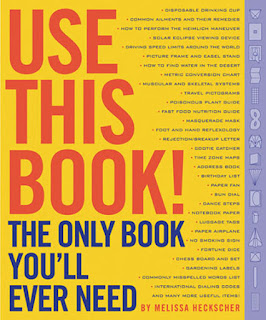
Use This Book - the only book you'll ever need

It slices! It dices! It's the Swiss Army Knife of books! The most useful book in the world! Chockfull of tools, charts, rulers, gadgets, form letters, and more, Use This Book can be employed in thousands of everyday situations.
  • Forgot your watch? Turn to page 157 and assemble a sun dial.
  • Need a drink? Go to page 193 and fold together a drinking cup.
  • Desperate to beat the heat? Open to page 197 and build yourself a cooling fan
  • Stuck on a commuter rail line? Jump to page 153 and cut out the chess board, complete with game pieces

And that's just the beginning. Page 151 features a template for the perfect paper airplane. Pages 155–156 feature maps of the world. Page 9 features a No Parking sign. Also included are luggage tags, dance steps, an eye doctor's test chart, and much, much more. With an engaging design and loads of helpful instructions, Use This Book is an essential companion for readers of all ages. Don't leave home without it!

Melissa Heckscher is the author of Be Safe! (Quirk, 2004) and Date Him or Dump Him? (Quirk, 2005). She lives in Los Angeles.

£14.99 from our East Dulwich store; Roullier White, 125 Lordship Lane, London SE22 8HU or on line from www.roullierwhite.com

Thursday, February 01, 2007

Caring for your fine metals


Caring For Your Fine Metals
by William Block, Founder of Cape Cod® Polish Company, Inc.


Silver
Sterling silver is a term used to specify that the metal contains at least 925 parts of silver to 75 parts of copper. Pure silver is rarely used, as it is too soft. The term "Sterling" is derived from an English penny, coined in the Middle Ages. "Sterling" became the standard for British coins. Unfortunately, there is no magic formula for keeping silver bright. Metallurgists have worked for years to produce a stain less silver, but without luck so far. So if you want your silver to look its best you are going to have to give it a reasonable amount of care. Wash your silver promptly after each use with hot suds. Rinse in hot water and dry immediately. If you follow this procedure, you won't have to polish often. When using your silverware, rotate it in daily use so that the finish will mellow uniformly.
There are several methods of cleaning tarnished silver but hand rubbing with a pre-moistened Cape Cod® Metal Polishing Cloth is best. The cloths have been impregnated with a very gentle polish in exactly the right amounts. They leave no excess in crevices as pastes or liquids do. To polish your silver, take time to do it carefully. To protect your hands wear gloves if you like. Rub each piece briskly, but not hard, using even, straight strokes. Wipe dry with a soft paper towel. You may wash flatware and other pieces you eat from in a mild detergent after polishing.


Silver Plate
Silver-plated articles should not be confused with solid silver or sterling silver. ln silver plate, a coating of silver has been applied to another metal. The care of silver plate is the same as for solid silver, except that it should be polished, perhaps, with less energy. Be particularly gentle with plated items, or you may totally remove the thin coating of silver and expose the copper or other metal underneath. Always test on an inconspicuous portion.

Proper Storage of Silver
Silver, like gold, is chemically inactive. Which means it doesn't oxidize when exposed to air, but its surface tarnishes from exposure to certain gases in the air. Therefore, if air is kept away, the tarnish is diminished.
Other enemies of silver are pollution, perspiration, table salt, eggs, olives, salad dressings, peas, gas, sulphur, vinegar, fruit juices, perfumes and toilet water. Don't let any of these come in contact with silver for long. Sea air and leaking gas tarnish silver very quickly. Watch your fruit and flower bowls, because the acids generated by decaying flowers, leaves and fruits will etch into your silver, causing ugly little pit marks. Empty silver salt dishes after each use, or the salt will pit them, causing permanent damage. Also, if you use silver candy, nut or serving dishes, wash and dry them thoroughly afterward to remove all possible damaging food residue. Store polished items in drawers or containers lined with flannel or toweling. Do not wrap silver in felt or chamois leather. Both are sources of hydrogen sulfide, a strong tarnish inducer. Never wrap plated silver in newspaper. Printers ink will act in time to remove the plating. Never secure any wrapping with rubber bands. Rubber, a deadly enemy of silver, can corrode it in a few weeks through several layers of paper or flannel. It is better not to keep rubber in same drawer or container.


Brass and Copper
Brass is an alloy of copper and zinc. Two parts of copper usually are used to one part of zinc. Oxidation causes brass and copper to darken and lose its luster. Tarnish on brass and copper can be removed by simply rubbing the item with a Cape Cod® Metal Polishing Cloth and wiping dry with a soft paper towel. Quickly, you will notice a lovely mirror shine and because of its anti-tarnishing feature you won't have to polish as often.
Heavy corrosion on brass or copper should be removed before polishing. Try a piece of lemon dipped in salt, or hot vinegar and salt, to remove corrosion from brass. This is an old-fashioned method but one that I find useful when dealing with articles that are difficult to clean. Provided they are not decorated with materials that hot water will damage, they can also be boiled in water containing salt and vinegar. Most of the corrosion will be loosened or removed. You can then finish with a
Cape Cod® Metal Polishing Cloth to restore the desired shine.
For antique brass, rub with lemon (mineral) oil and polish softly.
Copper can be given a deep-brown or bronze color by repeated wiping, after thorough cleaning, with boiled linseed oil. 

Brass on Wood
Most museum staffs now prefer that brass pulls and knobs do not gleam brightly, but be allowed to tone down to a soft patina. If you want to shine them, remove them from furniture and rub with
Cape Cod® Metal Polishing Cloths (Many old brasses are handmade and too fragile to be removed. In this case try to slip a piece of plastic or aluminum foil between brass and wood to protect the wood while polishing.)

Plated Brass or Copper
Plated articles should not be confused with solid brass or copper. In brass and copper plated items, a coating has been applied to another metal, usually steel but sometimes white metal (also known as "pot metal".) One way to determine whether an item is solid brass or copper is to test it with a magnet. If the magnet adheres then the metal is steel that has been plated. If it doesn't adhere there is a good chance it is solid brass or copper unless it is "pot metal." (Scratch the bottom - if there is white under the plate it is not solid.) Be particularly gentle with plated items, or you may totally remove the thin coating and expose the other metal underneath. Always test on an inconspicuous portion.

Chrome
On the chrome trim of a car, bike or motorcycle periodic applications of car wax can hold corrosion at bay. This is also helpful in the bath on chrome shower heads and nozzles where watermarks are visible. If the chrome is discolored, a light rubbing with a Cape Cod® Metal Polishing Cloth will restore it.

Pewter
On pewter, many people prefer to leave a dull gray patina. In the case of low-glow pewter, a soap-and-water bath is the most maintenance its finish ever needs. If you prefer a brighter shine rub with a
Cape Cod® Metal Polishing Cloth. Pewter is often displayed on oak but shouldn't be stored in a closed cabinet or drawer, because the organic acids in oak or in untreated, unseasoned woods promote pewter deterioration.

Stainless Steel
If you see stains or discoloration on stainless steel don't be surprised. All it promised was to stain less and not rust. It does not promise non-staining steel. It does stain, no matter what you do. I have found the best way to keep stainless steel clean is with a white nylon scrub sponge and a little ammonia solution. This should keep stainless steel looking as good as new. If it becomes dull or stained rub in one direction with a
Cape Cod® Metal Polishing Cloth and wipe dry to a finished shine.

Lacquered Metals
Lacquered brass needs only dusting and an occasional washing with luke warm water and mild detergent. Rinse and dry. If the lacquer becomes damaged and tarnish lines begin to show, or if the lacquer is turning dark, it can be removed with acetone or amyl acetate (banana oil). Coated objects can also be stripped with a solution of baking soda and boiling water (1 cup soda to 2 gallons boiling water.) Let the article stand in the water until it cools and peel off the lacquer. Before any polish can work, the metal surface must be free of all lacquer.
  • Each tin contains:
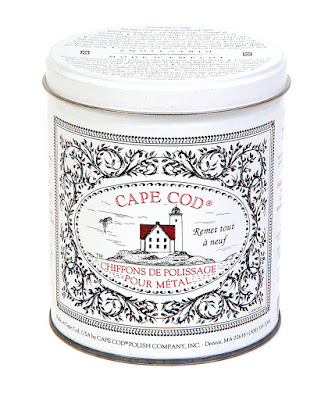
    Twelve 4" X 6" Cape Cod® Metal Polishing Cloths: moist polishing cloths that clean, polish, and protect any type of metal
  • One dusting & buffing cloth
  • One pair of reusable gloves to keep hands clean

£15 from our store in East Dulwich, Roullier White LTD, 125 Lordship Lane, London SE22, 8HU or on line at www.roullierwhite.com